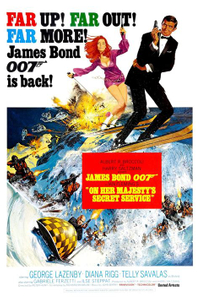
James Bond tracks his archnemesis, Ernst Blofeld, to a mountaintop retreat where he is training an army of beautiful, lethal women. Along the way, Bond falls for Italian contessa Tracy Draco, and marries her in order to get closer to Blofeld.
I had always heard this film was weak, that George Lazenby lacked charisma and that it was little more than a mistake in the saga. But watching it in full, the impression changes: it is far from the disaster people claim, and actually has a special value that perhaps wasn’t appreciated back in 1969.
The first surprise is how much it connects with the Daniel Craig era. Beyond the action —which here is more physical and less dependent on gadgets— there’s the portrayal of a vulnerable Bond, marked by tragic loss. That human angle, so unusual at the time, is precisely what makes the film more appreciated today.
Lazenby is not Connery, of course, but he’s not as bad as his reputation suggests. He lacks polish, but he holds his own in the action scenes and shares genuine chemistry with Diana Rigg, who truly elevates the film. Her Tracy is a strong character, and their relationship gives the story an emotional weight rarely seen in the franchise.
The movie has memorable sequences: ski chases, a charismatic (if over-the-top) Blofeld played by Telly Savalas, and an ending that remains one of the most shocking in the series. It may have seemed odd or out of place back then, but with time it has gained recognition and is now seen as a key step in Bond’s evolution.
It’s not perfect —some excesses and awkward moments remain— but it’s far more valuable than it was once thought to be. Today, it can be appreciated as a bridge between the classic and the modern Bond, one that dared to show that even 007 could lose.









Comments